

How to Choose a LIMS for Manufacturing Quality Control
June 4, 2026



The LIMS Evaluation Problem Most Labs Face
The LIMS category in North America is crowded and, on the surface, difficult to differentiate. Vendor websites use similar language. Demo environments show polished interfaces. The problem is that most LIMS evaluations are conducted against feature checklists, which tell you what a platform can theoretically do, not whether it will actually work for your lab's specific environment, compliance requirements, and operational reality.
This guide is structured around the decisions and tradeoffs that actually determine whether a LIMS succeeds or fails in a manufacturing quality lab context.
Step 1: Define What Your Lab Actually Needs Before Talking to Any Vendor
The most expensive LIMS mistake is selecting a platform based on what it does rather than what your lab requires. Before any vendor conversation, get clear on these four questions:
What is your primary lab function?
A manufacturing quality lab running high-volume release testing against defined specifications has fundamentally different requirements than a pharmaceutical development lab. The LIMS you need is one built for your actual workflows.
What are your specific compliance requirements?
FDA 21 CFR Part 11, ISO/IEC 17025, AAFCO, cGMP, or customer-imposed quality standards? Each has specific implications for system architecture. Know which standards you must meet and verify the platform enforces them natively.
Who will own and maintain the system?
If the answer to who maintains this after go-live is the lab team, the platform must be configurable and maintainable without vendor engineering.
What does the next three years look like for your lab?
Match the platform to your realistic growth horizon. A platform designed for a 500-person enterprise is not the right fit for a 15-person quality lab.
Step 2: Understand the Three Tiers of the North American Manufacturing LIMS Market
Tier 1: Enterprise Incumbents
LabWare, STARLIMS, LabVantage Solutions, and Thermo Fisher Scientific collectively hold approximately 80% of the global LIMS market. Built for large enterprises with complex integration requirements and multi-year implementation timelines.
Right for: Fortune 500 manufacturers with dedicated informatics staff and implementation budgets measured in hundreds of thousands to millions of dollars.
Not right for: Mid-market manufacturing labs that need to go live in months with no dedicated IT team.
Tier 2: Cloud-Native Challengers
QBench, Lockbox LIMS, Scispot, and similar platforms have gained ground in G2 rankings. QBench earned five first-place rankings in G2's Spring 2026 reports. Lockbox holds 4.9 out of 5 on G2. These platforms prioritize deployment speed and modern interfaces.
Watch for: The depth of compliance architecture in regulated manufacturing environments. Verify audit trails, electronic signatures, and method controls meet your specific regulatory requirements.
Tier 3: Industry-Specific Platforms
Platforms purpose-built for specific manufacturing verticals offer workflows, terminology, and compliance frameworks aligned to the actual regulatory environment. myLIMS by Confience occupies this space for quality testing and regulatory compliance labs in manufacturing.
Step 3: Evaluate on These Six Criteria
Criterion 1: Compliance Architecture
Ask vendors to explain how their platform enforces compliance, not just whether it is capable of compliance.
- Is the audit trail built into every transaction, or is it configurable?
- Are electronic signatures natively Part 11 compliant?
- How does the system enforce ISO 17025 method version control?
Criterion 2: Instrument Integration
Ask for a live demonstration with instruments you actually use, not instruments the vendor selects for the demo.
Criterion 3: Configuration and Ongoing Maintenance
- Can your team configure workflow changes without vendor engagement?
- What does adding a new method or sample type require?
- What is the typical turnaround time and cost for a configuration change?
Criterion 4: Implementation Timeline and Resources
- What is the typical time from contract signing to go-live for a lab like yours?
- What does the implementation require from your team in terms of time and internal resources?
Criterion 5: Total Cost of Ownership
Ask for the full three-year cost, not just the annual license fee. Implementation, training, validation documentation, configuration services, and integration work are often larger than the subscription fee.
Criterion 6: Vendor Stability and Roadmap Alignment
- What percentage of the customer base operates in regulated manufacturing?
- How does the roadmap account for evolving regulatory requirements?
Step 4: Run a Real Pilot, Not a Demo
A polished demo tells you what a LIMS looks like when everything works. A pilot with your actual data, methods, and workflows tells you whether it will work for your lab. When structuring a pilot, insist on:
- Your sample types and test parameters, not the vendor's pre-configured examples.
- Your compliance scenario: run an audit trail query, execute an electronic signature, change a method and verify version control.
- Your team running the system, not the vendor's implementation team.
- A realistic volume scenario. If you process 200 samples per day, test at that volume.
The Decision Framework
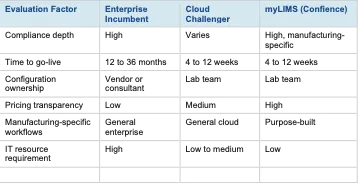
The Bottom Line
Choosing a LIMS for a North American manufacturing quality lab is not a feature comparison exercise. It is a decision about which platform your team can actually own, operate, and trust for the next several years in a regulatory environment that does not stand still.
Evaluate on compliance architecture, not compliance claims.Test with your data, not demo data. Ask for the full cost, not the subscription fee. And choose a platform built for the environment you actually work in.



.webp)