Traceability as a Competitive Advantage for Modern Laboratories
August 10, 2026



The word that sounds like a cost
Say traceability to most lab leaders and watch what happens. The shoulders tense a little. The word has come to mean paperwork, audit trails kept because a regulation says so, evidence gathered after the fact to satisfy someone else. It sounds like a tax on doing the real work. That reading is understandable, and it is also the single most expensive misunderstanding a lab can carry, because it treats a source of advantage as a cost of doing business.
Here is the reframe. Traceability is not the record you produce for an auditor. It is the ability to stand behind every result your lab has ever released, to anyone who asks, with the evidence already in hand. A lab that can do that moves faster, wins more trust, and takes on work its competitors cannot. The compliance benefit is real, but it is the smallest part of the story.
What traceability actually buys you
Think about the moments that decide whether a lab keeps a client or loses one. A customer disputes a result. An auditor asks how a number was reached three years ago. A regulator opens an inquiry. A court wants to know who touched a sample and when. In every one of those moments, the lab that can produce a continuous, defensible electronic chain of custody in minutes is in a completely different position from the lab that has to go digging through spreadsheets, email, and paper to reconstruct what happened.
That difference is not compliance. It is commercial. The first lab keeps the client, wins the audit, and closes the inquiry with its reputation intact. The second lab spends weeks proving it did nothing wrong, and even when it succeeds, the doubt lingers. Chain of custody discipline, backed by chain of custody software that captures every step, is what lets a lab defend its results to auditors, customers, and courts without hesitation. A lab that can defend everything can promise more, and a lab that can promise more can compete for work the others have to decline.
Why the foundation has to be built in, not bolted on
The catch is that traceability cannot be manufactured at the moment you need it. If the chain has gaps, no amount of effort during an audit will close them, because the evidence was never captured in the first place. A result copied by hand from an instrument to a spreadsheet has already broken the chain. A handoff between systems that no one logged is a blind spot no report can fill later. Traceability is either present continuously, from sample tracking at intake to final result, or it is not really there at all.
This is why it has to be an operating state rather than a reporting exercise. When every result points back to its source, every handoff is owned and recorded, and every action is attributable to a person, the lab does not prepare for scrutiny. It is always ready for it. That readiness is the promise the platform is built to keep: Gain complete traceability with access to trustworthy data to always be ready for audits, decisions, and expansion. The audit is just the day the rest of the world sees what the lab already had.
Industry analysis of digitized quality control labs supports the practical case for building this foundation. In its 2019 study of the future of pharmaceutical quality control, McKinsey estimated that digitization use cases in those labs demonstrated more than a 65 percent reduction in deviations and over 90 percent faster deviation closure, and cut quality control lab lead times by 60 to 70 percent. Those are McKinsey estimates for pharmaceutical quality control labs, not universal guarantees, but they describe the mechanism plainly. When the record is continuous and connected, the lab spends far less time chasing what went wrong and proving what went right, and far more time moving work forward.
The transparency argument runs deeper than data
There is a second kind of traceability that buyers rarely name but always feel, and it is about the vendor, not the lab. A vendor willing to show you exactly who can touch your data, and exactly what the platform costs, is making the same promise in two languages. Both are a refusal to hide the ball. A lab that has fought a system with surprise costs after the contract was signed knows the feeling of a vendor who was not transparent, and it is the same uneasy feeling as data whose history cannot be traced.
This is where transparency of price and transparency of data meet. Everything your lab needs for one transparent, predictable price - simple to buy, simple to budget, simple to trust. A vendor that commits to that kind of clarity on cost is showing the same character it needs to show on data lineage, access control, and accountability. Buyers evaluating a platform for the long term are right to read one as a signal of the other. Transparency is not a feature. It is a posture, and it is either there across the board or it is missing.
The question worth carrying into a vendor conversation
So the useful question for a lab leader is not whether a platform can generate an audit report. Almost any system can produce a document on demand. The question is whether the platform maintained a continuous, trustworthy record in the first place, so that the report is simply a view of the truth rather than a reconstruction of it. Ask a vendor to trace a single result back to its origin, live, and watch whether the answer is instant or improvised. The instant answer is what a competitive advantage looks like in practice.
Where this lands for Confience
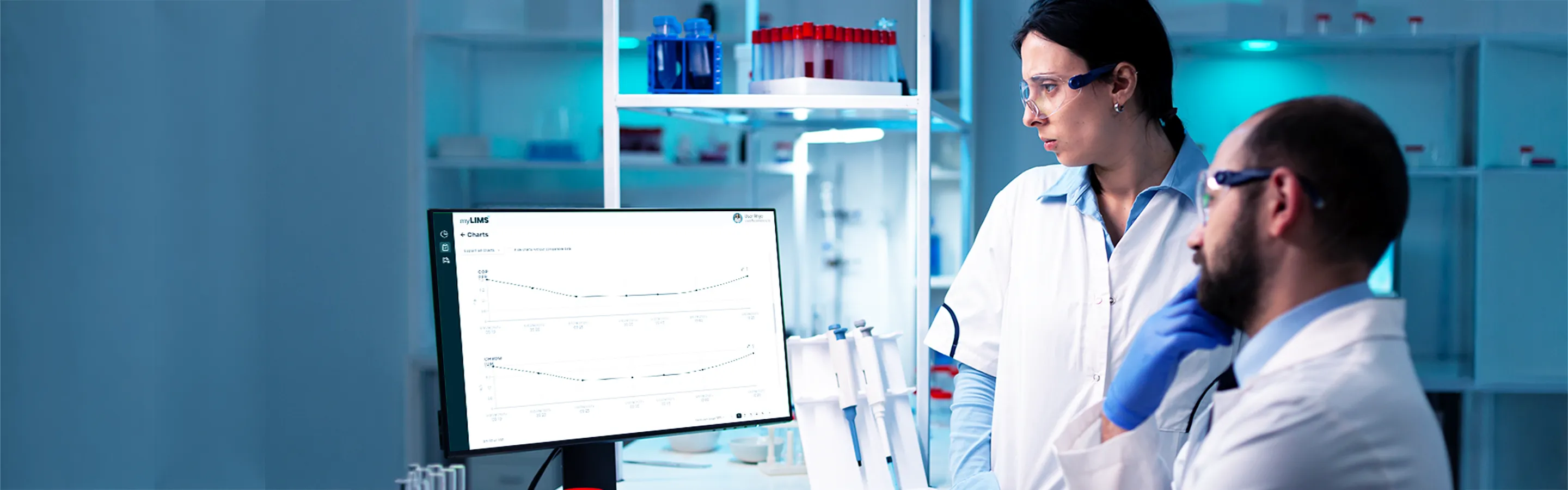
This is the argument behind how myLIMS, the Confience laboratory information management system (LIMS), is built. Connecting systems, removing manual transcription, and holding one continuous chain of custody are not there to win an audit. They are there so the trustworthy record is the only record, which means the lab can defend any result, to anyone, at any time, without scrambling. That is what turns traceability from a cost the lab absorbs into an advantage the lab uses. And because the platform is guided by teams who understand regulated science, that record holds its integrity as the lab's requirements and scale change, rather than degrading the moment the lab grows past the system it started on.